


Sugar vs Jaggery vs Honey ? Are You Ready
Every Indian kitchen has at least two of these three. You grew up with one, switched to another because someone said it was “healthier,” and now you’re not sure what to believe. Here’s the truth — and it’s more nuanced than the wellness world wants you to think.
The Sweet Trap We All Fall Into
Priya, a 34-year-old software professional from Bengaluru, switched from sugar to jaggery two years ago. “My nutritionist said it was natural, so it must be better,” she told her doctor during a routine check-up. Her blood sugar had still crept up. Her doctor’s response was blunt: “Natural doesn’t automatically mean harmless.”
India is the world’s largest consumer of sugar, according to the USDA Foreign Agricultural Service. Meanwhile, honey and jaggery are flying off shelves as “healthier alternatives” but are they? Let’s break this down, nutrient by nutrient, calorie by calorie.
The Sweet Trap We All Fall Into
Priya, a 34-year-old software professional from Bengaluru, switched from sugar to jaggery two years ago. “My nutritionist said it was natural, so it must be better,” she told her doctor during a routine check-up. Her blood sugar had still crept up. Her doctor’s response was blunt: “Natural doesn’t automatically mean harmless.”
India is the world’s largest consumer of sugar, according to the USDA Foreign Agricultural Service. Meanwhile, honey and jaggery are flying off shelves as “healthier alternatives” but are they? Let’s break this down, nutrient by nutrient, calorie by calorie.
What You’re Actually Eating
Sugar vs Jaggery vs Honey: Which Sweetener Is Actually Better for You?
Every Indian kitchen has a ritual. Tea with two spoons of sugar. Laddoos made with jaggery. A spoonful of honey stirred into warm water every morning. We’ve been told for years that one of these is the villain and the other two are heroes. But here’s the truth all three sweeteners raise your blood sugar. The question is by how much, how fast, and what else they bring to the table.
India is battling a diabetes crisis. According to the International Diabetes Federation’s Diabetes Atlas 2023, over 101 million Indians now live with diabetes and unchecked sugar consumption is one of the central drivers. Yet millions continue reaching for “natural” alternatives like jaggery and honey, believing they are making a smarter health choice. Are they?
Breaking Down What’s Inside Each Sweetener
Let’s start with the chemistry. All three sweeteners are primarily made of sugars, glucose, fructose, and sucrose in varying proportions. But their composition, glycemic index, and micronutrient content differ significantly.
White sugar is almost pure sucrose — 99.9% carbohydrates with zero fibre, zero minerals, and zero vitamins. It is highly processed, stripped of every trace of nutrition that the sugarcane originally carried. Its glycemic index (GI) sits at around 65.
Jaggery (gur), made by boiling raw sugarcane juice or palm sap, is 65–85% sucrose with small amounts of glucose and fructose. Unlike sugar, it retains iron, magnesium, potassium, and some B vitamins because it skips the refining stage. Its GI is slightly higher than sugar — estimated between 68 and 84, depending on the source.
Honey contains a mix of fructose (38%), glucose (31%), and water (17%), with trace amounts of antioxidants, enzymes, vitamins, and minerals. Its GI varies widely — from 35 for dark raw honey to 58 for lighter processed varieties. A 2022 review published in Nutrition Reviews found that raw honey shows modest antioxidant and antimicrobial activity compared to refined sugars.
| Sugar GI | Jaggery GI | Honey GI |
| 65 | 68-84 | 35-58 |
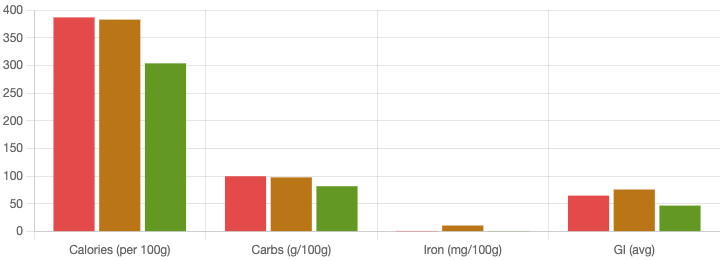
Nutritional comparison: Sugar, Jaggery, and Honey per 100g — calories, carbs, iron content, and average glycemic index.
The Glycemic Index Myth That Fools Most People
Here’s what most wellness content conveniently skips: jaggery has a higher glycemic index than white sugar, not lower. Most people who switch to jaggery, thinking it is “safer” for blood sugar, are making a choice that could be counterproductive, especially for those with prediabetes or insulin resistance.
A study published in the Indian Journal of Medical Research found that consuming jaggery caused a similar spike in post-meal blood glucose levels as white sugar in healthy adults. The iron and mineral content in jaggery is real, but the amounts are too small per daily serving (1–2 teaspoons) to make a meaningful clinical difference unless jaggery is consumed in cooking quantities.
Honey comes out ahead on the glycemic index front, but only if you are using raw, unfiltered honey. Most commercial honey sold in India is processed, diluted, or adulterated. A 2022 investigation by the Centre for Science and Environment (CSE) found that several leading honey brands in India failed purity tests. Adulterated honey has none of the antioxidant or enzyme benefits that make raw honey worth choosing.
What the Calories Actually Tell You
Did you know?
This means you can use less honey to achieve the same sweetness — making it calorie-efficient when used sparingly. But most people use it in equal amounts and end up consuming similar calories.
Honey has 25% fewer calories per 100g than sugar but it is 1.5× sweeter.
Honey’s sweetness advantage means smaller quantities can deliver the same taste but this only works if you actually use less.
Honey has around 304 calories per 100g versus sugar’s 387. Jaggery sits at 383. But honey is roughly 1.5 times sweeter than table sugar due to its high fructose content. In theory, you need less honey to sweeten your chai. In practice, most people use the same amount. The calorie advantage disappears.
The WHO’s 2023 guidelines on non-sugar sweeteners note that no sweetener, sugar-based or otherwise, should be used as a primary health strategy. The goal should be reducing total sweet consumption, not switching brands.
The One Area Where the Differences Are Real
Despite the largely similar glycemic impact, there are genuine functional differences between these three sweeteners that matter for specific health needs.
For iron deficiency: Jaggery wins. A 100g serving contains about 11mg of iron, roughly 60% of the daily recommended intake for adult women. ICMR data shows that iron deficiency anaemia affects nearly 57% of Indian women aged 15–49. Jaggery used in cooking (not just a spoon in tea) can contribute meaningfully to iron intake.
For antimicrobial and wound-healing properties, Raw honey wins but it needs to be actual raw honey. Manuka honey, for instance, has been studied extensively by the NIH for its antimicrobial activity due to its hydrogen peroxide content and low pH. For everyday use, local raw honey from verified sources carries similar (though weaker) benefits.
For everyday cooking and baking, Sugar wins on consistency. Jaggery’s mineral content causes variation in taste and colour, and honey’s fructose content makes it hygroscopic absorbing moisture and can make baked goods dense and overly soft.
For diabetics: None of them is safe in large quantities. The American Diabetes Association recommends counting all added sugars, regardless of source honey, jaggery, and white sugar, all count equally toward your daily sugar budget.
The 5-Second Rule Most Nutritionists Use
Dr. Rupali Datta, a well-known Indian clinical dietitian, has repeatedly said in public forums: “The best sweetener is the one you use the least of.” This is the rule that cuts through the marketing noise. Jaggery over white sugar? Fine you get trace minerals. Raw honey over jaggery? Fine, you get antioxidants. But if you’re doubling the quantity because it feels “healthier,” you’ve lost the game entirely.
Here’s a practical framework based on these differences:
- Use jaggery when cooking Indian sweets, dals, and chutneys — especially if you have iron deficiency
- Use raw honey as a topping or in salad dressings where it won’t be heated (heat destroys its enzymes and antioxidants)
- Use sugar when baking where precise texture matters and quantity is small
- Reduce all three — that’s the only strategy with consistent evidence behind it
What About “Natural” Always Meaning Better?
Priya’s doctor, the one we met at the start, was right to push back. The wellness industry has built an enormously profitable business on the word “natural.” But arsenic is natural. Snake venom is natural. The word describes source, not safety.
According to a 2023 meta-analysis published in BMJ Open, substituting jaggery or honey for sugar produced no significant long-term benefit for metabolic health markers when total calorie intake was controlled. The benefits appear only when the switch also involves eating less of the sweetener overall.
The truth is uncomfortable but simple: all three raise blood sugar. All three contribute to dental decay. All three can contribute to weight gain in excess. Jaggery and honey have minor nutritional advantages at very high intakes but at the teaspoon level of daily use, the differences are clinically insignificant for most healthy adults.
The Bottom Line
India does not have a sugar-type problem. It has a sugar quantity problem. The ICMR dietary guidelines recommend limiting free sugar intake to less than 10% of total daily calorie consumption about 50g or 10 teaspoons for a 2000-calorie diet. Most urban Indians consume nearly double that.
Switch from white sugar to jaggery if the iron and mineral trace benefits feel meaningful to you. Choose raw honey if you can verify its purity and use it in cold applications. But don’t confuse switching with reducing. The sweetener that’s best for your health is the one sitting in a smaller spoon.