



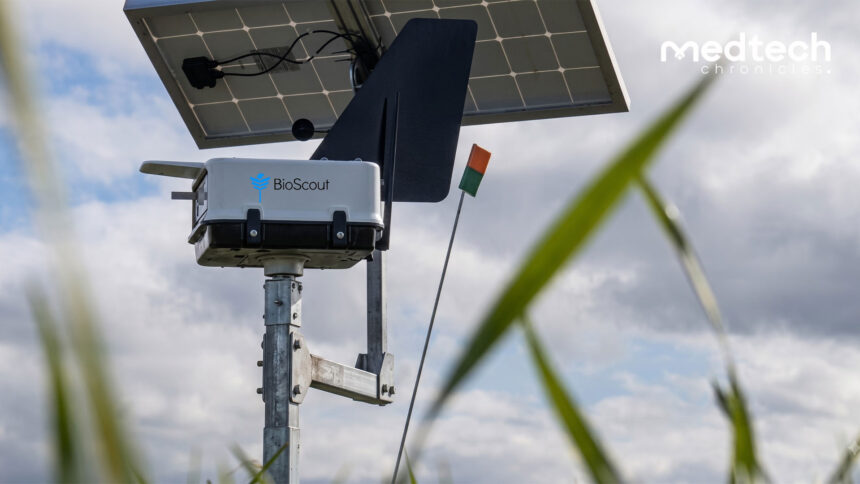
BioScout has raised A$6.75 million (US$4.8 million) in seed funding as the Australian agritech company looks to expand its technology for detecting airborne crop diseases. The Sydney-based company plans to use the new funding to strengthen its presence in Europe and expand its sensor network from about 250 units today to 1,000 by 2029.
The funding round was co-led by Demea Sustainable Investment and Astanor. GrainInnovate, GrainCorp Ventures, Hort Innovation Venture Fund, Artesian and Division Q also participated in the round.
BioScout Targets Early Detection of Crop Diseases
Crop diseases can become difficult and expensive to control once visible symptoms appear. Farmers often rely on preventive fungicide programs because they may not know when a pathogen is present or how quickly it is spreading. BioScout is developing an early-warning system designed to provide that information earlier. Its technology continuously samples the air and captures airborne particles, including fungal spores, using a sensor placed in the field.
The collected material is automatically examined under a microscope, which captures high-resolution images. BioScout then uses trained detection models to identify spores in those images. The company combines the information with environmental conditions such as temperature, humidity, rainfall, atmospheric pressure, and wind conditions to assess potential disease risk.
Each sensor can monitor more than 40 airborne threats, including crop-disease spores, pollen and other particles. The company says its system can help growers understand not only whether a pathogen is present but also how its concentration changes over time.
Funding Will Support European Expansion
BioScout will use the new capital to expand its international operations, with Europe among its key priorities. The company currently has about 250 sensors in its network and wants to increase that number to 1,000 units by 2029.
The company already has deployments across several agricultural markets. Its technology has been used in Australia, New Zealand, Europe, South Africa, and the United States, with potatoes emerging as one of its important markets. BioScout also expects to have around 20 to 25 systems operating in Brazilian soybean fields by the end of 2026, according to AgFunderNews.
Technology Designed for Farmers
BioScout’s system is designed to give farmers an earlier view of disease pressure instead of relying only on visible symptoms or fixed spraying schedules. The company says growers can receive alerts when spore levels increase and can use the data alongside their existing spray programs. This can help farmers decide when they need to inspect crops more closely or consider treatment.
Founder and CEO Lewis Collins described the technology as similar to a weather warning system, but focused on crop disease. The company aims to identify potential threats while there is still time for growers to respond.
BioScout says its technology can potentially reduce fungicide use in some situations. Collins told AgFunderNews that growers can cut spray costs by up to 50% in certain cases. That figure represents the company’s reported experience and should not be treated as a guaranteed saving for every farm.
Growing Focus on Potatoes and Soybeans
Potatoes have become a significant area of focus for BioScout because growers face strong disease pressure and challenges related to fungicide performance. The company has deployments involving potatoes across Europe, South Africa, Australia, New Zealand and the United States. Brazilian soybeans represent another potential growth market. BioScout expects to deploy 20 to 25 systems in Brazilian soybean fields by the end of this year.
The company is also exploring applications for other crops and diseases. Its sensors can be configured according to the crop and pathogen because different diseases can spread across very different distances.
From PhD Project to Global Agritech Company
BioScout began as Collins’ PhD project at the University of Sydney. It has since developed into a company with operations across multiple countries. Collins said the company now has a team of about 30 people and operates on five continents. The company currently uses machine learning primarily to identify spores in microscope images. It is also exploring how to combine spore information with weather data, spray programs, field observations and grower notes.
With its latest A$6.75 million seed funding, BioScout now plans to increase its sensor network and expand into more international markets. Its goal is to give farmers earlier information about airborne disease threats so they can make more informed decisions about crop protection. The latest investment marks another step in BioScout’s effort to turn real-time disease monitoring into a practical tool for farmers and agricultural businesses worldwide.