

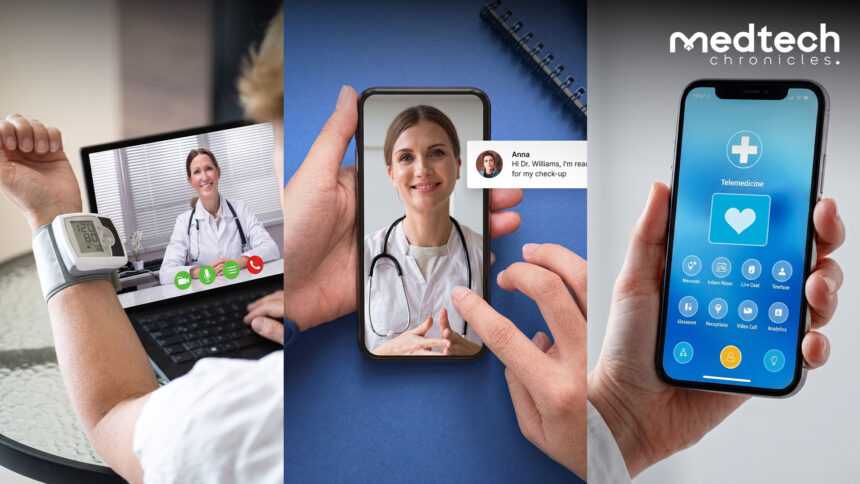
Somewhere in Ohio right now, a woman with high blood pressure is stepping on a bathroom scale that’s quietly sending her weight to a cardiologist forty miles away. She hasn’t touched a video call button. She isn’t on hold. She doesn’t even know today is a “monitoring day.” That’s remote patient monitoring, and it’s a completely different animal from the telehealth visit she has scheduled for next Tuesday, even though most people, understandably, use these words like they’re interchangeable.
They’re not. And if you’re trying to figure out remote patient monitoring vs telehealth vs telemedicine, whether you’re a patient trying to understand your care plan, a practice owner deciding what to build next, or just someone who got a bill with a confusing code on it, the distinctions actually matter. They affect what you experience, what gets billed, and who’s watching your health data while you sleep.
Let’s untangle it.
What’s the Actual Difference Between These Three Terms?
Here’s the short version: telehealth is the umbrella. Telemedicine is one thing under that umbrella. Remote patient monitoring is a more specific thing under that. Telehealth sits at the top of the hierarchy, with telemedicine as a type of telehealth defined as practicing medicine at a distance, the act of a provider examining, observing, and treating a patient remotely.
Think of it like nesting dolls. Telehealth is the biggest doll on the outside. Crack it open, and telemedicine is inside. Crack that open, and RPM is inside. Every RPM program is a form of telehealth. Not every telehealth interaction is RPM. And telemedicine sits somewhere in the middle, doing the work of connecting a real clinician to a real patient in real time.
Telehealth Is the Umbrella. Here’s What Sits Under It.
Telehealth is a broader, more general term encompassing the entire industry, technologies, and methodologies used to deliver remote healthcare, and that’s a much bigger tent than most people realize. It’s not just video calls with your doctor.
It includes video conferencing, secure messaging, and mobile health applications, and covers more than clinical services, patient education, public health initiatives, and remote healthcare administration, all of which fall under it too. A hospital sending automated appointment reminders? Telehealth. A nurse triage line? Telehealth. A diabetes education app that isn’t connected to any device? Also telehealth.
That’s the key distinction people miss: telehealth doesn’t require a clinician to be actively treating you in the moment. It just requires technology to bridge some distance in the healthcare experience.
Telemedicine: The Part Where a Clinician Actually Treats You
Telemedicine is narrower, and it’s the piece most of us have actually experienced. It specifically refers to providing clinical services at a distance, remote diagnosis, treatment, and monitoring of patients, and while telemedicine is always a form of telehealth, not all telehealth activities qualify as telemedicine.
So when you log into a video call, describe your sore throat, and get a prescription called into your pharmacy, that’s telemedicine. A real, licensed provider made a real clinical judgment about you, in real time, just not in the same room.
The clinical process here leans on subjective, in-the-moment information. Providers observe you, ask questions, and make judgments based on conversation and visual cues during the call, the same instincts they’d use in an exam room, just filtered through a screen.
Remote Patient Monitoring: The Part That Never Clocks Out
RPM is where things get genuinely different, and it’s the piece with the most momentum right now. Remote patient monitoring is a subset of telehealth that uses FDA-cleared devices to monitor, collect, and send a patient’s vital signs and other health data to their doctor.
Unlike a telehealth visit, nobody’s on a call. Nobody’s being “seen.” RPM has the benefit of continuously monitoring a patient, while telehealth services are usually designated for appointments at certain times; that continuous, ambient quality is really the whole point.
The Devices Doing the Actual Work
Some commonly used RPM devices include blood pressure monitors, glucose meters, thermometers, and scales, unglamorous hardware that quietly does something a once-a-year checkup never could: catch a trend before it becomes an emergency.
And the objectivity matters. Remote patient monitoring generates objective physiological data through FDA-cleared medical devices, such as blood pressure readings, oxygen saturation, and glucose values, that reveal trends invisible during a single-point-in-time consultation. A doctor’s visit catches a snapshot. RPM catches the whole movie.
Is Remote Patient Monitoring the Same as Telehealth?
No, RPM is a subset of telehealth, not a synonym for it. Telehealth is the broad category covering any remote healthcare technology, while RPM specifically means continuous device-based data collection between visits, without a live clinical interaction happening at the same moment. RPM also happens to be asynchronous by definition, which is exactly why it’s billed and coded so differently, more on that below.
That said, they’re built to work together, not compete. In many cases, using both options helps keep patients safer and healthier than relying on either alone, and layering telehealth into an RPM-based routine can cut back on costs and time demands even further.
Where Each One Actually Shows Up in Practice
Definitions are one thing. Watching these three tools actually work is another.
Cardiology and the Pacemaker That Talks
A patient with an implanted cardioverter-defibrillator doesn’t think about RPM at all; the device just reports in. That’s remote patient monitoring at its most invisible: no app to open, no button to press, just a pacemaker or ICD quietly transmitting rhythm data to a cardiology team that can catch an arrhythmia days before it becomes a hospital admission.
Diabetes and the Glucose Trend Line
For a Type 2 diabetes patient, a connected glucose meter sends daily readings automatically. When the numbers start trending the wrong way over two weeks, that’s when a telemedicine visit gets scheduled, not a guess, but a response to an actual pattern the provider watched build in real time.
Post-Surgical Recovery Without the Waiting Room
After a hip replacement, a patient might use a wearable to track mobility and pain scores (RPM), check in with a physical therapist over video twice a week (telemedicine), and receive automated medication reminders through a patient portal (telehealth, but neither of the other two). Three different tools, three different jobs, one recovery plan. It’s a model gaining real policy backing, too; a bipartisan federal funding package extended the Acute Hospital Care at Home program through 2030, effectively betting that this blended approach belongs in mainstream care, not just as a pandemic-era stopgap.
Why the Billing Codes Matter More Than the Vocabulary
If you run a practice, the vocabulary debate is mostly academic. The billing distinction is not. CMS treats these services completely differently, and getting it wrong is how claims get denied.
RPM has its own family of CPT codes, 99453, 99454, 99457, 99458, and 99091, separate from Remote Therapeutic Monitoring codes, which cover non-physiological data like medication adherence. Telehealth visits, by contrast, generally ride on standard office-visit codes (99202–99215) with a place-of-service code (02 or 10) and modifier attached, rather than a special code family of their own.
2026 brought the biggest shakeup to this system since the pandemic. CMS finalized new RPM codes, CPT 99445 for shorter 2-to-15-day data windows and CPT 99470 for 10-to-19-minute clinical management sessions, specifically to stop excluding patients whose monitoring didn’t fit the old 16-day, 20-minute thresholds. On top of that, CMS increased RPM and Chronic Care Management reimbursement rates by roughly 7–21% for 2026, while explicitly declining to cut the existing 99457 and 99458 rates despite recommendations to do so.
One rule trips up a lot of billing teams: RPM does not require real-time audio-video because it’s asynchronous by definition, so RPM codes should never carry a telehealth modifier or place-of-service code. That’s a distinct system from telehealth billing, not a variation on it.
Telehealth also picked up permanent footing this year. CMS permanently removed frequency limits on subsequent inpatient, nursing facility, and critical care telehealth visits, restrictions that used to force artificial gaps between visits regardless of clinical need. And documentation requirements tightened across the board: RPM billing now demands timestamps showing when data was reviewed, notes on what it showed, and the clinical decisions that followed, closing the door on the looser paperwork practices used to get away with it.
The Trust Problem Nobody’s Solved Yet
None of this works if patients don’t trust it, and right now, plenty don’t.
Patient engagement is the top strategic priority for virtual care leaders heading into 2026, with more than half naming it their number one focus, and technical reliability hasn’t caught up either: 91% of telehealth leaders report at least occasional video call disruptions. That’s a frustrating gap between the promise of seamless remote care and the reality of a frozen screen mid-appointment.
The trust gap isn’t uniform, either. European respondents cite lack of patient trust as a key barrier nearly twice as often as their North American counterparts, 50% versus 28%. while data security concerns run in the other direction, with 16% of North American leaders flagging it as a major challenge compared to 10% in Europe. Different regions are worried about different things, but they’re all worried.
And the barriers aren’t just about trust; they’re structural. Limited internet access, inadequate cellular data, and low digital literacy disproportionately affect people in rural areas, racial and ethnic minorities, and patients with lower socioeconomic status, the exact populations remote care is often pitched as helping most. That’s the uncomfortable irony sitting underneath a lot of the enthusiasm: the tool built to close access gaps can just as easily widen them if the rollout doesn’t account for who’s being left out.
Where This Is All Headed in 2026
The money moving into this space tells its own story. The global remote patient monitoring market was valued at roughly $28.9 billion in 2024 and is projected to climb toward $138 billion by 2033, a compound annual growth rate of nearly 19%, driven by chronic disease prevalence, aging populations, and the broader shift toward value-based care.
And it’s not a niche bet anymore. IQVIA projects that by 2030, more than 142 million U.S. patients, nearly 40% of the population, will be using some form of RPM technology. That’s not “early adopters.” That’s mainstream chronic care management, and Medicaid is catching up to match it: RPM is now covered in some form by 41 state Medicaid programs as of January 2026.
Cardiology remains the anchor use case, but it’s spreading. Cardiology accounted for the largest share of the RPM market in 2024, while the software segment is expected to post the fastest growth going forward at close to a 15% CAGR. Translation: the hardware race is maturing, and the real competition is shifting toward who can make sense of all that data.
Side by Side: The Quick-Reference Comparison
| Scope | Broadest, the umbrella term | Narrower, clinical care specifically | Narrowest, continuous device data |
| Requires live clinician interaction? | Not always | Yes | No, asynchronous by definition |
| Data type | Varies (video, messages, education) | Subjective, conversation-based | Objective, device-generated |
| Typical devices | Phone, laptop, tablet | Phone, laptop, tablet | Blood pressure cuffs, glucose meters, scales, pacemakers |
| Billing | Standard visit codes (99202–99215) + POS/modifier | Standard visit codes + POS/modifier | Dedicated CPT codes (99453, 99454, 99457, 99458, 99091, 99445, 99470) |
| Best for | Education, admin, general access | Diagnosis, treatment, prescriptions | Chronic disease trend tracking |
Which One Does Your Situation Actually Need?
If you need a doctor to look at you and make a call, a rash, a med adjustment, a follow-up question, that’s telemedicine. If you’re managing something like hypertension, diabetes, or heart failure and your care team wants to see patterns over weeks, not minutes, that’s remote patient monitoring doing what it’s built for. And telehealth? That’s just the name for the whole system that makes both of those things possible without you driving anywhere.
Most people don’t need to pick one. The patients getting the best outcomes right now are usually the ones using all three: a monitor quietly doing its job at home, and a real clinician stepping in exactly when the data says it’s time.