



Put an Oura Ring on one hand and an Apple Watch on the other wrist, sleep one ordinary night, and check both apps in the morning. They won’t agree. Not by a rounding error, either, often by 30 to 45 minutes on individual sleep stages. One tells you that you barely touched deep sleep. The other says you had a great night. Somebody’s lying to you, and figuring out who is exactly what this comparison is for.
The smart ring vs smartwatch sleep tracking debate isn’t really about which gadget looks cooler on your hand (though, sure, that’s part of it for some people). It’s about which sensor location and which company’s algorithm gets closer to what’s actually happening inside your body while you’re unconscious and can’t correct for it.
Is a Smart Ring Really More Accurate Than a Smartwatch?
Yes, generally, for sleep staging specifically. A 2024 study run by researchers at Brigham and Women’s Hospital, funded by Oura but independently designed and conducted, found the Oura Ring outperformed both the Apple Watch and Fitbit for four-stage sleep classification when measured against polysomnography, the lab-based gold standard. The Oura Ring was found to be 5% more accurate than the Apple Watch and 10% more accurate than Fitbit in four-stage sleep classification compared to polysomnography. Worth flagging up front: Oura funded this study, which doesn’t invalidate the results; it was still peer-reviewed and independently run, but it’s a detail worth keeping in your back pocket while reading the numbers below. The devices tested were also the Oura Ring Gen3 and Apple Watch Series 8, both now a couple of hardware generations behind current models, so treat these figures as directionally reliable rather than a guarantee for whatever ring or watch you’d buy today.
The Finger vs. The Wrist: Why Location Changes Everything
Here’s the part that actually explains the accuracy gap, and it has nothing to do with software.
Your finger has arteries sitting closer to the skin’s surface, packed into a denser capillary bed than anything at the wrist. For a light-based heart sensor, the photoplethysmography (PPG) tech every one of these devices runs on, that’s the difference between reading a clean signal and reading one full of static. Less motion, less noise, better data going into the algorithm before it even starts guessing at sleep stages.
That’s why, physiologically, rings had a head start before Oura or Samsung wrote a single line of sleep-staging code. It’s also why a ring can occasionally out-measure a much more expensive, more sensor-packed watch on this one specific job.
Oura vs. Apple Watch: What the Hospital Study Actually Found
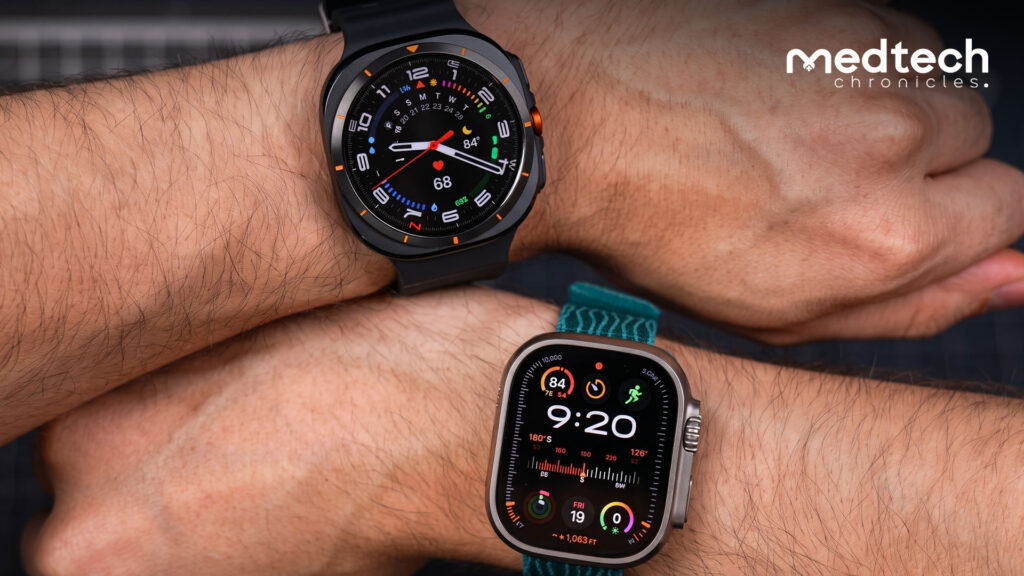
The Brigham and Women’s Hospital researchers put the Oura Ring Gen3, an Apple Watch Series 8, and a Fitbit Sense 2 on 35 healthy adults for a single overnight stay, wired up to full polysomnography at the same time. For detecting sleep vs. wake, sensitivity was 95% or higher for all three devices, so if the only thing you care about is “did I sleep or not,” pick whichever one you find comfortable, because they all nail that part.
The Numbers Nobody Puts in the Marketing Copy
Sleep-stage detection is where things get messier. Sensitivity for discriminating between sleep stages ranged from 50% to 86% across devices: the Oura Ring landed between 76.0–79.5%, Fitbit between 61.7–78.0%, and the Apple Watch between 50.5–86.1%. Look at that Apple Watch range for a second: 50.5% at the bottom. That’s close to a coin flip on some nights. The watch can be brilliant or barely-better-than-guessing depending on the person, the night, and how tight the band was.
Oura’s range is narrower and consistently higher. The Oura Ring wasn’t statistically different from polysomnography for wake, light sleep, deep sleep, or REM estimation, which is about as strong an accuracy claim as a consumer device gets.
A separate, more recent five-night study covering Apple Watch, Oura, Whoop, Fitbit, and Garmin found something equally useful for setting expectations: Apple Watch was the most accurate for awake time but less reliable for deep sleep, while Fitbit and Garmin showed more variability. And in a detail that matters more than any of the averages, no single device worked perfectly for everyone; some users found the Apple Watch highly accurate while others ranked it lower, and the Oura Ring had a similar split. Your mileage really does vary, based on your skin, your finger size, how you sleep, how much you toss around.
Where Samsung’s Galaxy Ring Fits Into the Fight
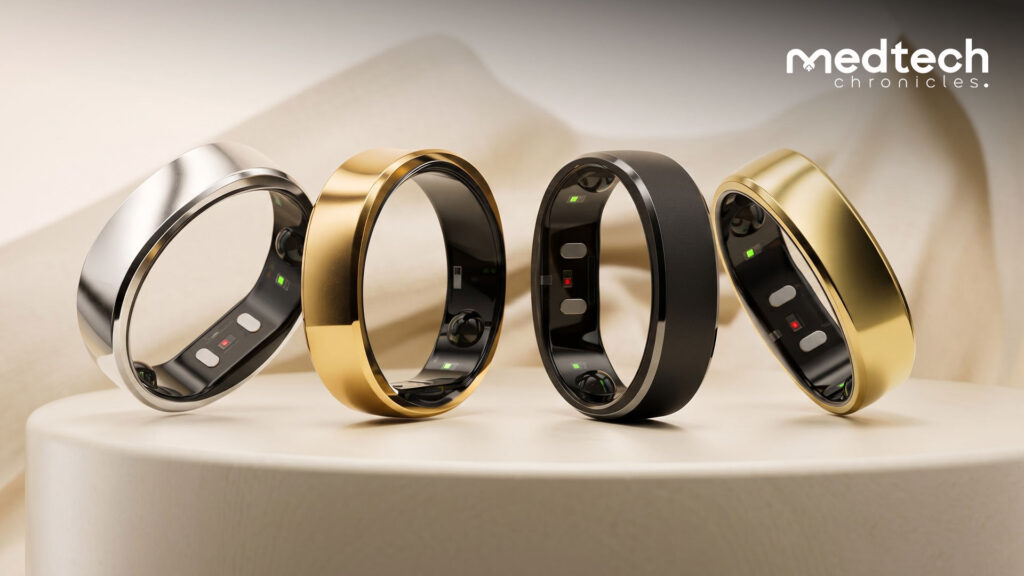
This is the part where honesty matters more than a clean answer. Samsung’s Galaxy Ring tracks the full suite: accelerometer, optical heart rate sensor, and a temperature sensor for tracking health and fitness data, with temperature also used to help predict menstrual cycles, and it bundles those readings into an “Energy Score” alongside data from a paired Galaxy Watch. samsung
But independent lab validation hasn’t caught up to the marketing yet. As of mid-2026, one detailed hands-on review put it plainly: Samsung Health’s sleep and recovery modeling is newer than Oura’s decade of algorithm refinement, and independent validation of the Galaxy Ring’s HRV and sleep-stage accuracy is still pending, with the manufacturer’s accuracy claims treated as unverified until bench-tested against a reference device. Early hands-on impressions have been more mixed than glowing, too; testing shows excellent heart rate accuracy during rest, though some users report inconsistencies in sleep duration and deep sleep tracking compared to Oura, and one buyer’s guide noted occasional nocturnal heart rate flatlines and periodic unnatural drops in SpO2 readings during testing.
Translation: if you’re deep in the Samsung ecosystem already, the Galaxy Ring is a genuinely convenient option. Just don’t assume it’s matched Oura’s sleep-staging accuracy yet; the receipts aren’t in.
HRV: The Metric Where Rings Actually Pull Ahead
If sleep staging is a close-ish race, HRV isn’t. This is where the finger’s physiology really shows off.
A 2025 systematic review pulling from 107 clinical studies and roughly 100,000 participants found smart rings achieve a heart rate correlation of r² = 0.996 against ECG, near-perfect, with HRV correlation at r² = 0.980. To put that in plain terms: if your ring shows a resting heart rate of 58 bpm, the true ECG-equivalent reading would almost certainly fall between 56 and 60 bpm.
A more recent independent validation, run across 13 participants and 536 nights of data against a Polar H10 chest strap, backed this up: premium ring-type devices achieved high concordance with the ECG reference, confirming that finger-based PPG delivers clinically meaningful resting heart rate and HRV data. Worth noting, chest straps are still the undisputed champion for HRV precision, especially during exercise, when rings and watches both start guessing more than measuring. But for the overnight numbers that actually drive your morning readiness score, rings are close enough to the lab standard that the gap barely matters for everyday use.
Body Temperature: The Quiet MVP Metric
Nobody brags about temperature tracking the way they brag about sleep scores, but it might be the most underrated metric in this whole comparison. Both Oura and the Galaxy Ring track continuous skin temperature overnight, and both use deviations from your personal baseline, not the absolute number, to flag illness, cycle-phase shifts, or poor recovery before you consciously feel anything’s wrong.
The ring’s advantage here is basically mechanical. A watch loosens on your wrist through the night; a ring stays snug against skin that doesn’t move much once you’re asleep. Consistent contact means a cleaner baseline, and a cleaner baseline means the deviation alerts are actually trustworthy instead of noisy.
Why Your Devices Never Agree
So why do your ring and watch disagree so often? Different sensor placement, different proprietary algorithms trained on different populations, and different definitions of what even counts as “light sleep” versus “core sleep” under the hood. None of them are lying to you exactly; they’re just each making an educated, occasionally very different, guess.
The Subscription Question: What Each Ring Actually Costs You
Accuracy is only half the buying decision; the other half is what you’re paying to actually see the numbers. This is where Oura’s advantage gets more complicated.
Oura’s hardware works without a membership, but its full readiness, sleep, and long-term insights sit behind Oura Membership at $5.99 a month or $69.99 a year. The Galaxy Ring, RingConn Gen 2, and Ultrahuman Ring Air all take the opposite approach: full features with no required subscription. Run the math over three years, and it stings a little; Oura becomes the priciest mainstream option over three years at roughly $509 total, versus $349 for the Ultrahuman Ring PRO over the same period. Vora + 2
Samsung leaned into this as a selling point at launch. When the Galaxy Ring launched in 2024, its $399.99 price was $199.99 more expensive up front than the Oura Ring Gen3, but Samsung stuck with a subscription-free model, which gave it an edge on long-term cost despite the higher sticker price. So the honest framing: Oura costs less to buy and more to own over time. Samsung, RingConn, and Ultrahuman cost more (or the same) up front and nothing extra to keep using. notebookcheck
One more wrinkle: if you’re on iPhone, the Galaxy Ring only makes sense if you own a recent Galaxy phone; on iPhone or non-Samsung Android, you lose gestures, some app features, and clean Apple Health integration. Oura, by contrast, works across both ecosystems. Smart Rings Reviews
What Happens When You Actually Work Out?
Everything above applies to lying still overnight. The moment you start moving, the story flips.
Rings are built to disappear on your finger while you sleep, not to survive a deadlift session. Grip-based lifting, cycling, and rowing all challenge ring accuracy and comfort, so a watch remains the better pick for real-time workout tracking. That tracks with the sensor physics covered earlier: a ring can rotate mid-set, losing the exact alignment its PPG sensor needs, right when your heart rate is changing fastest. Vora
Smartwatches don’t have that problem to nearly the same degree, and the Apple Watch in particular leans hard into this strength: it can track more than 80 different exercise types, including running, HIIT, rowing, swimming, and strength training, and can even estimate load during weight training. None of the rings in this comparison attempt anything close to that. Garage Gym Reviews
So if your goal is understanding your sleep and recovery, a ring wins. If your goal is getting detailed data mid-workout, you still want something on your wrist.
Battery Life: The Unsexy Metric That Decides Your Data Gaps
This sounds like a footnote until you realize it directly affects the sleep data you’re trying to compare in the first place.
Rings sip power because they’re not running a screen. The Oura Ring 4 lasts roughly 7 to 8 days on a charge, the Samsung Galaxy Ring 2 runs 5 to 7 days, while even an efficient current-generation Apple Watch still needs charging every 1 to 2 days. Some rings go further still; the RingConn Gen 2 stretches to 10–12 days between charges. Vora Smart Rings Reviews
Why this matters for accuracy comparisons specifically: a watch that needs daily charging often means choosing between wearing it to bed on a low battery or charging overnight and losing that night’s data entirely, a gap rings largely eliminate, since you top them up for 20 to 60 minutes a week and wear them the rest of the time. If you’re trying to build an honest week-over-week HRV trend, a device that quietly skips nights isn’t just inconvenient; it’s actively worse data than a slightly less accurate device that never misses a night. Vora
So Which One Should You Actually Buy?
If sleep staging and HRV precision are what you actually care about, not step counts, not workout GPS, not notifications on your wrist, the ring wins this comparison, and Oura specifically has the most independently validated track record right now, even accounting for the subscription cost. If you want deep integration with a Samsung phone and are willing to treat “Energy Score” as directionally useful rather than clinically proven, the Galaxy Ring is a reasonable bet that’ll likely improve with software updates. And if you already live on your Apple Watch for workouts, calls, and notifications and just want a rough sense of how you slept? Keep wearing it, just don’t treat a “12% deep sleep” reading as gospel.
The most accurate tracker, in the end, is still the one you’ll actually wear every single night without fail. A perfect algorithm on a device sitting in a drawer measures nothing at all.