




She’d been told it was stressful. Then anxiety. Then “just irregular cycles.” It took three different doctors and nearly two and a half years before she finally got the answer: PCOS. Polycystic ovary syndrome. Something she’d had all along.
That story isn’t unusual. It’s practically the norm. But a landmark study from the National Institutes of Health suggests AI PCOS detection could be on the verge of changing that, and the accuracy numbers are difficult to ignore.
What Did the NIH Study on AI and PCOS Find?
NIH researchers conducted a systematic review of all peer-reviewed studies published over the past 25 years (1997-2022) that used AI and ML to detect PCOS. They didn’t just pull a handful of papers. They screened 135 studies and included 31 in the final analysis, finding that AI and ML-based programs were able to successfully detect the condition.
The headline number: among the 10 studies that used standardized diagnostic criteria to identify PCOS, detection accuracy ranged from 80 to 90 percent.
“Across a range of diagnostic and classification modalities, there was an extremely high performance of AI/ML in detecting PCOS,” said Dr. Skand Shekhar, senior author of the study and endocrinologist at the National Institute of Environmental Health Sciences (NIEHS). “These data reflect the untapped potential of incorporating AI/ML in electronic health records and other clinical settings to improve the diagnosis and care of women with PCOS.”
NIH Study: AI/ML Detects PCOS with 80–90% Accuracy
She’d been told it was stressful. Then anxiety. Then “just irregular cycles.” It took three different doctors and nearly two and a half years before she finally got the answer: PCOS. Polycystic ovary syndrome. Something she’d had all along.
That story isn’t unusual. It’s practically the norm. But a landmark study from the National Institutes of Health suggests AI PCOS detection could be on the verge of changing that, and the accuracy numbers are difficult to ignore.
What Did the NIH Study on AI and PCOS Find?
NIH researchers conducted a systematic review of all peer-reviewed studies published over the past 25 years (1997-2022) that used AI and ML to detect PCOS. They didn’t just pull a handful of papers. They screened 135 studies and included 31 in the final analysis, finding that AI and ML-based programs were able to successfully detect the condition. nih
The headline number: among the 10 studies that used standardized diagnostic criteria to identify PCOS, detection accuracy ranged from 80 to 90 percent. National Institutes of Health
“Across a range of diagnostic and classification modalities, there was an extremely high performance of AI/ML in detecting PCOS,” said Dr. Skand Shekhar, senior author of the study and endocrinologist at the National Institute of Environmental Health Sciences (NIEHS). “These data reflect the untapped potential of incorporating AI/ML in electronic health records and other clinical settings to improve the diagnosis and care of women with PCOS.” Mugglehead Investment Magazine
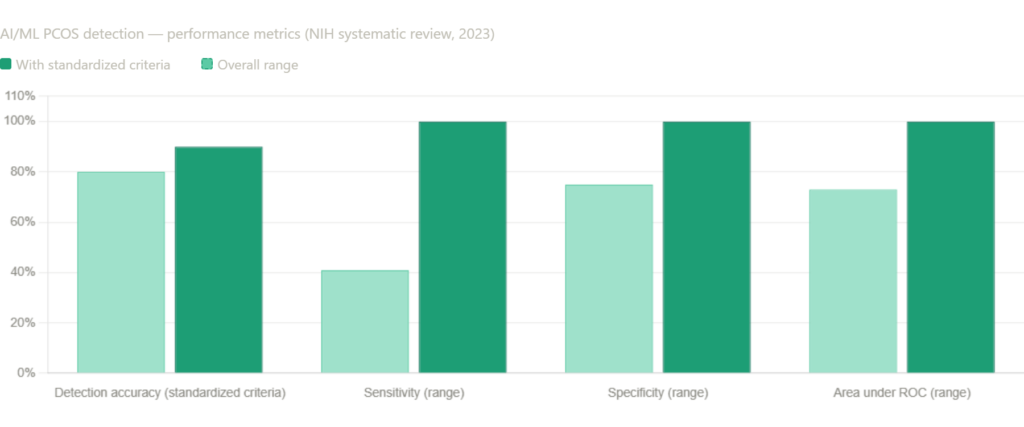
Source: NIH systematic review of 31 peer-reviewed studies (1997–2022). Sensitivity and specificity ranges drawn from 10 studies each; AUC from 7 studies.
Why Is PCOS So Hard to Diagnose?
PCOS is the most common hormonal disorder in reproductive-aged women. And yet, for all its prevalence, it remains one of medicine’s most quietly botched diagnoses.
An estimated 10 to 13 percent of women globally have PCOS, but up to 70 percent of affected women remain undiagnosed. Research shows women see an average of three physicians before receiving a PCOS diagnosis, with delays averaging more than two years from symptom onset.
Why? Because PCOS doesn’t announce itself clearly. Its features, irregular periods, elevated androgens, insulin resistance, acne, excess hair growth, frequently overlap with other conditions like obesity, diabetes, and cardiometabolic disorders, so it regularly goes unrecognized.
That’s not a small problem. PCOS is associated with increased incidence of cardiovascular disease, infertility, and endometrial cancer. Every year of delayed diagnosis is a year of compounding risk.
How AI and ML Actually Read PCOS
The Tools Doing the Heavy Lifting
So how does a machine do what three doctors sometimes miss? It comes down to data volume and pattern recognition, two things AI handles far better than any single clinician working from a 20-minute appointment.
The most common AI techniques used in the reviewed studies were support vector machines (42% of studies), K-nearest neighbor algorithms (26%), and regression models (23%). Ultrasound images were included in roughly half the studies, giving the algorithms visual data to scan alongside lab results and patient histories. nih
Convolutional neural networks (CNNs) in ultrasound and MRI studies reported high diagnostic performance and offered greater reproducibility than manual interpretation. Clinical and EHR-based models, commonly using support vector machines, random forests, or ensemble methods, frequently outperformed logistic regression in classifying PCOS risk.
What this means in plain terms: give the algorithm enough data, hormone levels, ultrasound images, medical history, and it can spot PCOS patterns that human review might miss or deprioritize.
What 80–90% Accuracy Actually Means
Here’s where context matters.
That 80–90% figure comes from studies that used standardized diagnostic criteria, the NIH criteria, Rotterdam criteria, or the Revised International PCOS classification. These are the gold-standard frameworks clinicians are supposed to use. The fact that AI matched or exceeded human performance within these frameworks is what makes researchers excited.
Across all 31 included studies, the area under the receiver operating curve ranged from 73 to 100 percent, diagnostic accuracy from 89 to 100 percent, sensitivity from 41 to 100 percent, and specificity from 75 to 100 percent. nih
That’s a wide range, and honestly, that’s the honest reading of where the field stands. AI PCOS detection isn’t a finished product. It’s a compelling proof of concept with genuinely strong numbers in controlled conditions. The challenge is moving those results out of peer-reviewed studies and into the exam room.
What Comes Next for AI PCOS Detection
The NIH researchers weren’t just celebrating the numbers. They were prescribing what needs to happen next.
The study authors noted that AI and ML-based programs have the potential to significantly enhance our capability to identify women with PCOS early, with associated cost savings and a reduced burden on patients and the health system. They called for follow-up studies with robust validation and testing practices to allow for smooth integration of AI and ML for chronic health conditions.
The authors proposed a comprehensive approach combining large-scale population studies with electronic health data analysis to pinpoint sensitive diagnostic biomarkers that could enhance the detection of PCOS.
Separately, a 2025 systematic review published in PMC, covering 80 studies from 1997 to March 2025, found that CNN-based models dominated imaging applications, with accuracies often exceeding 95 percent and occasionally reaching 98 to 99 percent. The field is moving fast.
But speed has to be matched by rigor. Small sample sizes, inconsistent diagnostic criteria, and limited external validation remain the main gaps between where AI PCOS detection is now and where it needs to be to actually reach patients.
In 2021, there were an estimated 65.8 million prevalent cases of PCOS globally. With prevalence rising and diagnostic delays still averaging two-plus years, the case for deploying AI in this space isn’t theoretical; it’s urgent.
What nobody should accept anymore is a woman sitting across from her third doctor in three years, still without an answer to something a well-trained algorithm might have flagged on her first visit.
Source: NIH systematic review of 31 peer-reviewed studies (1997–2022). Sensitivity and specificity ranges drawn from 10 studies each; AUC from 7 studies.
Why Is PCOS So Hard to Diagnose?
PCOS is the most common hormonal disorder in reproductive-aged women. And yet, for all its prevalence, it remains one of medicine’s most quietly botched diagnoses.
An estimated 10 to 13 percent of women globally have PCOS, but up to 70 percent of affected women remain undiagnosed. Research shows women see an average of three physicians before receiving a PCOS diagnosis, with delays averaging more than two years from symptom onset.
Why? Because PCOS doesn’t announce itself clearly. Its features, irregular periods, elevated androgens, insulin resistance, acne, and excess hair growth, frequently overlap with other conditions like obesity, diabetes, and cardiometabolic disorders, so it regularly goes unrecognized.
That’s not a small problem. PCOS is associated with increased incidence of cardiovascular disease, infertility, and endometrial cancer. Every year of delayed diagnosis is a year of compounding risk.
How AI and ML Actually Read PCOS
The Tools Doing the Heavy Lifting
So how does a machine do what three doctors sometimes miss? It comes down to data volume and pattern recognition, two things AI handles far better than any single clinician working from a 20-minute appointment.
The most common AI techniques used in the reviewed studies were support vector machines (42% of studies), K-nearest neighbor algorithms (26%), and regression models (23%). Ultrasound images were included in roughly half the studies, giving the algorithms visual data to scan alongside lab results and patient histories. nih
Convolutional neural networks (CNNs) in ultrasound and MRI studies reported high diagnostic performance and offered greater reproducibility than manual interpretation. Clinical and EHR-based models, commonly using support vector machines, random forests, or ensemble methods, frequently outperformed logistic regression in classifying PCOS risk.
What this means in plain terms: give the algorithm enough data, hormone levels, ultrasound images, medical history, and it can spot PCOS patterns that human review might miss or deprioritize.
What 80–90% Accuracy Actually Means
Here’s where context matters.
That 80–90% figure comes from studies that used standardized diagnostic criteria, the NIH criteria, Rotterdam criteria, or the Revised International PCOS classification. These are the gold-standard frameworks clinicians are supposed to use. The fact that AI matched or exceeded human performance within these frameworks is what makes researchers excited.
Across all 31 included studies, the area under the receiver operating curve ranged from 73 to 100 percent, diagnostic accuracy from 89 to 100 percent, sensitivity from 41 to 100 percent, and specificity from 75 to 100 percent. nih
That’s a wide range, and honestly, that’s the honest reading of where the field stands. AI PCOS detection isn’t a finished product. It’s a compelling proof of concept with genuinely strong numbers in controlled conditions. The challenge is moving those results out of peer-reviewed studies and into the exam room.
What Comes Next for AI PCOS Detection
The NIH researchers weren’t just celebrating the numbers. They were prescribing what needs to happen next.
The study authors noted that AI and ML-based programs have the potential to significantly enhance our capability to identify women with PCOS early, with associated cost savings and a reduced burden on patients and the health system. They called for follow-up studies with robust validation and testing practices to allow for smooth integration of AI and ML for chronic health conditions.
The authors proposed a comprehensive approach combining large-scale population studies with electronic health data analysis to pinpoint sensitive diagnostic biomarkers that could enhance the detection of PCOS.
Separately, a 2025 systematic review published in PMC, covering 80 studies from 1997 to March 2025, found that CNN-based models dominated imaging applications, with accuracies often exceeding 95 percent and occasionally reaching 98 to 99 percent. The field is moving fast.
But speed has to be matched by rigor. Small sample sizes, inconsistent diagnostic criteria, and limited external validation remain the main gaps between where AI PCOS detection is now and where it needs to be to actually reach patients.
In 2021, there were an estimated 65.8 million prevalent cases of PCOS globally. With prevalence rising and diagnostic delays still averaging two-plus years, the case for deploying AI in this space isn’t theoretical; it’s urgent.
What nobody should accept anymore is a woman sitting across from her third doctor in three years, still without an answer to something a well-trained algorithm might have flagged on her first visit.